| TEASE |
 |
In today's supermarket of the airwaves, branding is the way to
make your TV channel stand out. But who's in charge? The marketing
executives or the programme makers?
|
|
| INTRO
Roger Bolton
|
| Advertising is hard to escape nowadays. If it isn't the commercials
that pay for many of our programmes, it's the adverts TV stations
increasingly use to promote themselves. Branding your channel has
become a broadcasting obsession. Both ITV and Channel 5 have recently
changes their logos to sell a fresh image of themselves. And the BBC
was this week voted British Brand of the Century. Regular Right to
Reply viewer Andrew Wiseman reports on the rules of the TV branding
game. |
|
|
| Andrew, voiceover |
|

|
Spot the difference.
Three weeks ago Granada were using this logo.
|
|
And now they've switched to this one.
This is more than simple cosmetics - it's all part of a carefully
planned strategy
|

|
|
| |
Most of the ITV companies have recently changed their logos to say they're
part of one network, broadcasting "from the heart".
Welcome to the competitive world of television branding.
|
| Andrew in a supermarket |
 |
With up to 200 channels soon to be available in our living rooms,
the way a channel identifies and distinguishes itself from the competition
has never been more important. TV channels are now employing the same
techniques of branding that we see all around us. |
|
| INTERVIEW
Mark Earls
|
Mark
Earls
Planning Director,
St Lukes Advertising Agency |
The average supermarket now carries 20 000 individual product
lines. In order to get us to think about a particular product, the
owner of that particular product has to get us to think about it
before we get to the supermarket.
|
 |
|
Similarly in a world of multi-channel television, you have to get
people to know you're there, know what you stand for and to expect
a certain kind of programming when they arrive.
|
|
|
|
ITV's big re-branding was designed to make them stand out from the supermarket
of the airwaves by confronting a major identity crisis.
|
| INTERVIEW
Brian Eley
|
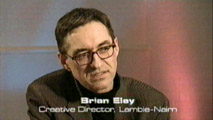 |
Brian
Eley
Creative Director, Lambie-Nairn |
Because it's a huge network of different regional companies, it's
always lacked a little a unified voice. It makes it very hard to
present itself strongly to an audience. Many of their most high
profile productions, the things they were proudest of, were very
often credited to the BBC.
|
|
| |
| So how does it work? Lambie-Nairn were the design consultancy who
had to make the ITV network branding work for one of the regional
companies, Carlton in London. |
 |
|
| |
 |
They simply wanted to have an expression of the heart which was
theirs alone. So we were asked to somehow square this circle, that
they were part of ITV and therefore of the heart but they were also
unique as a brand. And we came up with the proposition that, okay,
if ITV is the 'heart', Carlton is the 'star' of the ITV network. |
|
| |
| The service designers provide certainly doesn't come cheap. But
the stakes are high. The BBC say they spent well over a million pounds
on these now familiar logos. About as much as two hours of a costume
drama. But the Corporation had a vital message to transmit across
the crowded airwaves. |
 |
|
| |
 |
BBC One is based on the proposition that BBC One brings a world
of programming to every nation. And it's about pride in a national
institution. And after a few imaginative leaps, it takes you to a
hot air balloon taken to every part of the United Kingdom. |
|
| |
| I can't help wondering if some of these slick idents have higher
production values than the programmes themselves. |
 |
|
| |
How much do you value your reputation? That's what you're
talking about. But you can't make empty promises. You can't build up a brand
for something which is quite insubstantial. There has to be something there
for viewers to watch. |
| |
 |
That's the risk with branding, that the marketing glitz may end
up better than the content. It's a problem that afflicted Channel
5 when it launched 2 ½ years ago. |
|
| INTERVIEW
Jim Hytner
|
|
Jim
Hytner
Marketing Director, Channel 5
|
The launch itself was successful in establishing us as a big brand
or a big channel. But I'm not sure that we the channel has a good
enough feeling of what our programming was going to be and therefore
it was quite hard to express that to viewers.
|
 |
|
| |
It's a guide to the importance of marketing that Jim Hytner has been
dubbed "the most important man at Channel 5". He's now
re-branding as well, to make the image and the programmes match.
|
| |
 |
Our new idents involve our channel personalities, our channel celebrities,
who actually take the mickey out of the channel or take the mickey
out of themselves. It tries to express a confidence to the viewer
that we have about ourselves.
|
|
| |
| So branding is now the name of the game. But what about the future?
Marketeers have already seized control of the bits in between the
programmes. But how long before they begin to influence the programmes
themselves? |
 |
|
| |
Most marketeers would say absolutely, we should influence
the programme content. Should this happen in television? I think not. We
have a creative department called programme makers and I think it would
be a sad day if marketeers suddenly invent a formula whereby we can anticipate
viewing demands and some sort of factory piles it out. |